

Work |
The First NetZero Building for the Minnesota State University Network!
Winona, Minnesota, USA
Winona State University challenged our team with an ambitious question:
How can one building replace two outdated halls, unite three distinct departments, and become a resilient academic hub at the heart of campus?
Currently with a completed schematic design and developed in collaboration with the Perkins&Will Minneapolis studio, CICEL aspires to form a new campus gateway—an interdisciplinary home for Mathematics, Computer Science, and Art, along with shared classrooms, student services, and a vibrant campus commons. A hybrid steel and mass-timber structure supports ultra-low-carbon goals while responding to Minnesota’s climate extremes. Above it, a solar “super-roof” powers the project’s Net-Zero Energy ambitions and shelters a rooftop terrace overlooking the bluffs.
By consolidating 75,000 square feet onto a compact footprint, CICEL frees approximately one acre of land for a new restored greenspace, transforming former building sites into prairie habitat, outdoor learning areas, and a revitalized public realm.
When complete, CICEL will stand as a visible commitment to innovation, sustainability, and interdisciplinary learning across the Minnesota State system.
Winona State University
Architecture, Regenerative Design, Sustainable Systems Integration, Community Engagement
Pursuing Living Building Challenge 4.0, Net Zero Energy (Operational)
Winona, Minnesota, USA
77,000 SF new construction, 1 acre reclaimed greenspace
In-Planning / Estimated Occupancy Before 2030
Upper Midwest – Prairie and Bluff Ecosystem
Higher Education, Interdisciplinary Academic Building
What it is
A clear, welcoming campus heart where movement, daylight, and community converge.

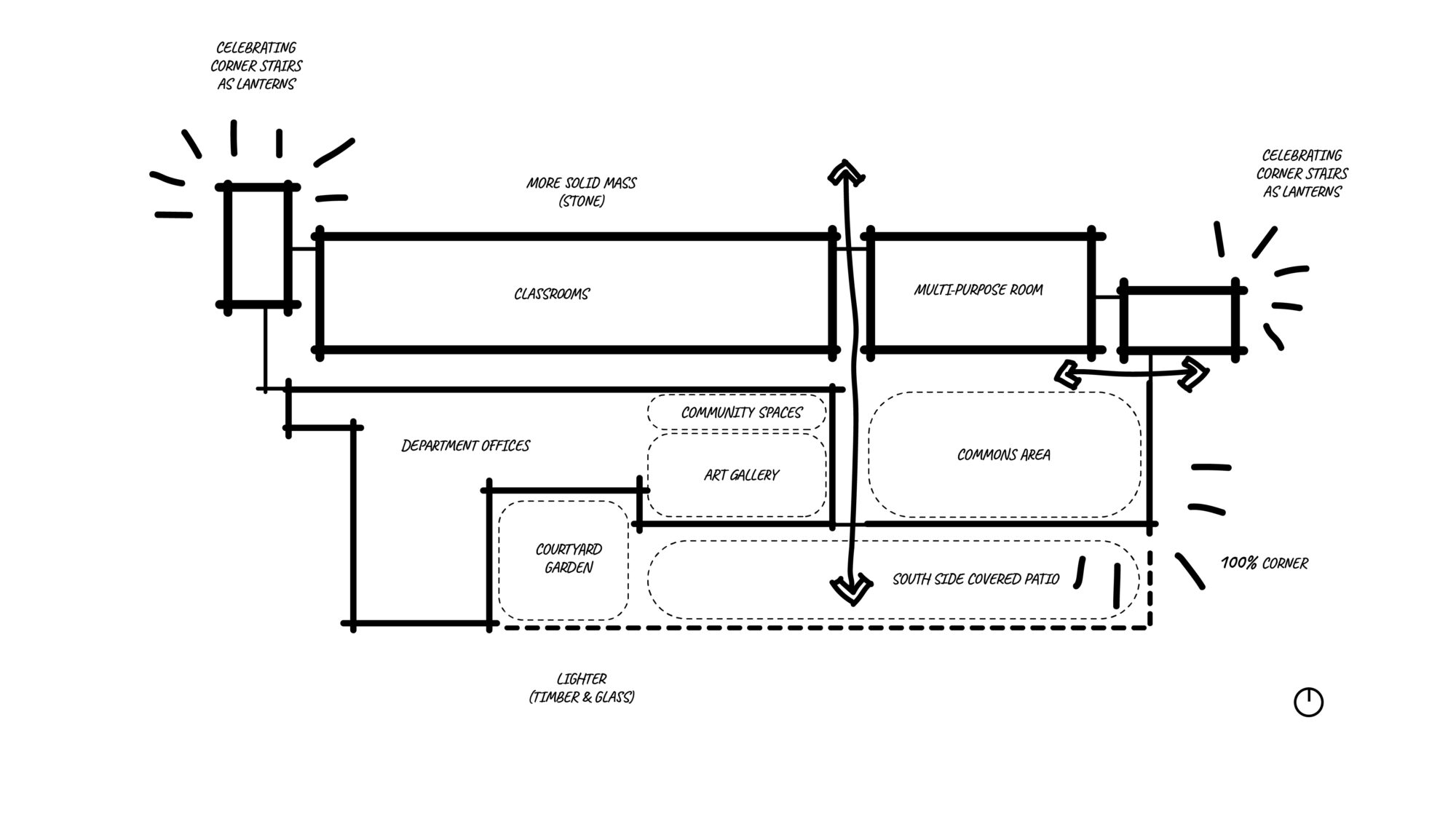
Concept & Parti
A Building that Connects
CICEL organizes classrooms along a solid northern limestone bar for glare-free daylight, with southern mass timber social spaces that bring warmth, openness, and flexibility. A generous central corridor threads these zones together as a communal spine, while integrated sustainable systems — solar canopy, geothermal, low-carbon materials, and stormwater management — enhance both ecological performance and occupant well-being. This parti expresses clarity, connection, and a balance between rigorous learning spaces and vibrant community life.


